
Life+ is the Fibre Net system designed to secure the intrados of floors made of hollow-core concrete (latero-concrete), steel, or timber, affected by detachment phenomena of non-structural elements (plaster, intrados tiles and, in hollow-core slabs, portions of infill blocks), commonly referred to as spalling.
The objective of the intervention is to contain potentially unstable elements, reducing the risk of falling material and improving safety during service.
In hollow-core slabs, spalling refers to the failure and detachment of the intrados tiles of the infill blocks. This phenomenon can be particularly critical, as the sudden collapse of ceiling portions may involve falling masses of approximately 25–40 kg/m², reaching up to 90 kg/m² in the most severe cases.
The causes are generally linked to a combination of factors: inadequate design choices or construction details, execution defects, material quality and degradation, changes over time in load and constraint conditions, unfavorable environmental conditions, and lack of maintenance.
The problem is frequently found in buildings constructed in the post-war period, particularly between the 1940s and 1970s, and is especially relevant in public buildings (schools, offices, sports facilities), where continuity of use and user safety require effective and rapidly deployable solutions.
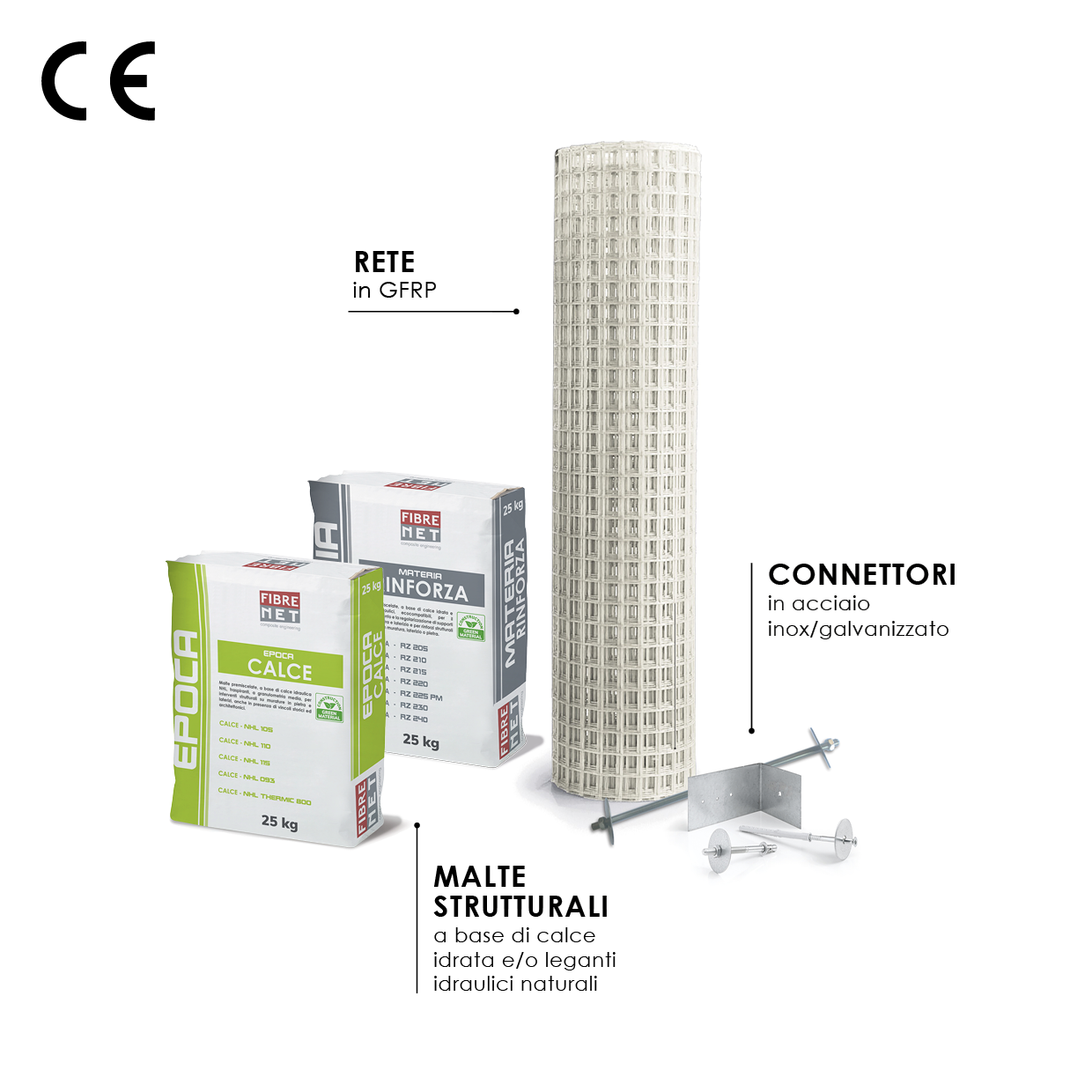
Life+ is the Fibre Net system for securing the intrados of floors in hollow-core concrete, steel, or timber structures affected by detachment of non-structural elements.
The LIFE+ system involves applying preformed glass fiber meshes with thermosetting resins to the intrados, anchored to the joists through specifically designed mechanical/structural connections.
This creates a continuous containment system capable of intercepting and retaining detached elements, preventing them from falling below the plane of the slab.
Once the intervention is completed, the reinforcement can be left exposed or finished with plaster or a suspended ceiling, depending on architectural and service requirements.
From an operational standpoint, the lightweight nature of the materials and the availability of meshes in rolls up to 100 m² facilitate handling and speed up installation.
The geometry and stiffness of the preformed meshes allow for fast application; any mortar finishing layer can be applied in a single coat, either manually or mechanically, without the need for “wet-on-wet” processes.
This results in reduced execution time and costs, as well as more efficient site management—particularly advantageous for interventions in occupied buildings.
Floors
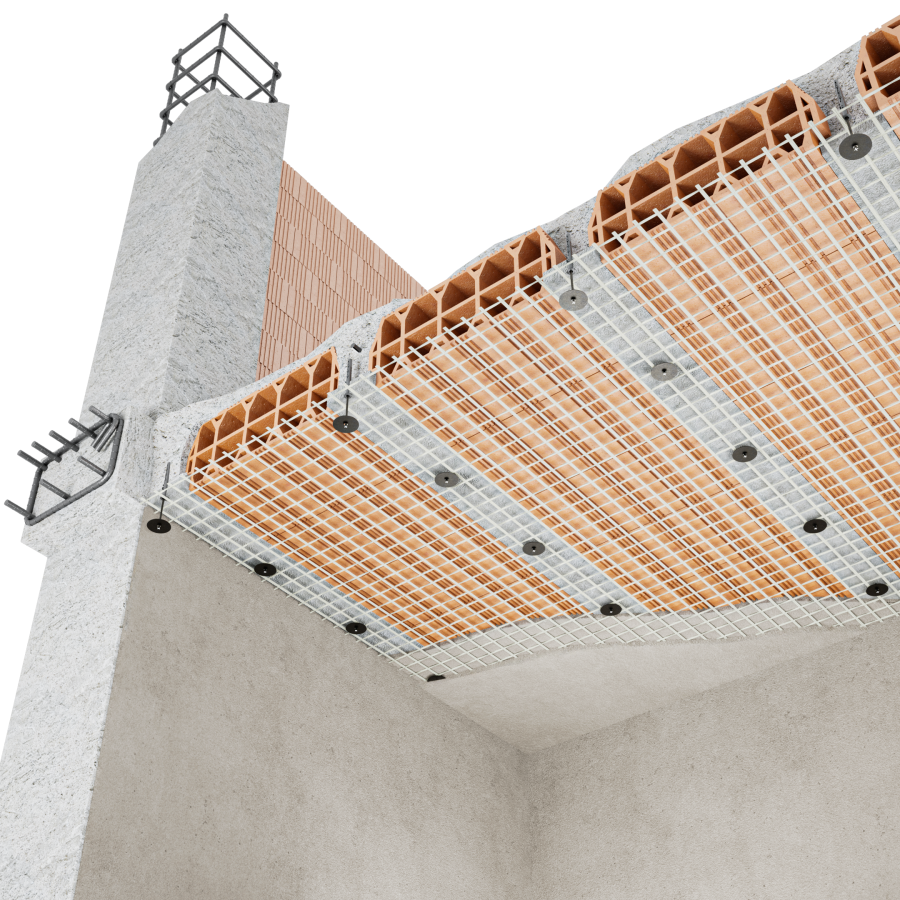
The anti-spalling safety intervention consists of installing, at the intrados of the floor, a continuous containment system aimed at preventing the سقوط of brick and plaster portions in case of detachment of the intrados tiles of the infill blocks.
Operationally, this involves installing a preformed mesh (typically glass fiber with thermosetting resin), mechanically anchored to the joists using connectors sized according to joist spacing, slab geometry, and potential detachment loads.
The mesh acts as a “harness” for the intrados: even in the event of failure of the infill blocks or detachment of plaster, fragments are intercepted and retained, preventing free fall and reducing risk to occupants.
Depending on performance and architectural requirements, the system can:
• be left exposed for direct inspection over time
• be plastered with a protective coating
• be covered with a suspended ceiling, while maintaining its containment function
It is important to note that this is a local safety intervention: it does not significantly modify the global structural behavior of the floor, but mitigates the risk associated with detachment of non-structural intrados elements, using a lightweight, fast, and site-compatible technology—particularly suitable for occupied buildings.

The system can be removed without permanently altering the existing floor. Ideal for protected buildings or structures subject to future interventions.
Glass fiber meshes provide high containment capacity with low weight. Loads are evenly distributed through the anchoring system.
Applicable to hollow-core concrete, steel, and timber floors, with adaptable solutions. It can be left exposed, plastered, or integrated with suspended ceilings.
Lightweight materials and fast installation reduce on-site time and complexity. Also suitable for occupied buildings, minimizing disruption to users.
 2
2
of 15









 Back to home